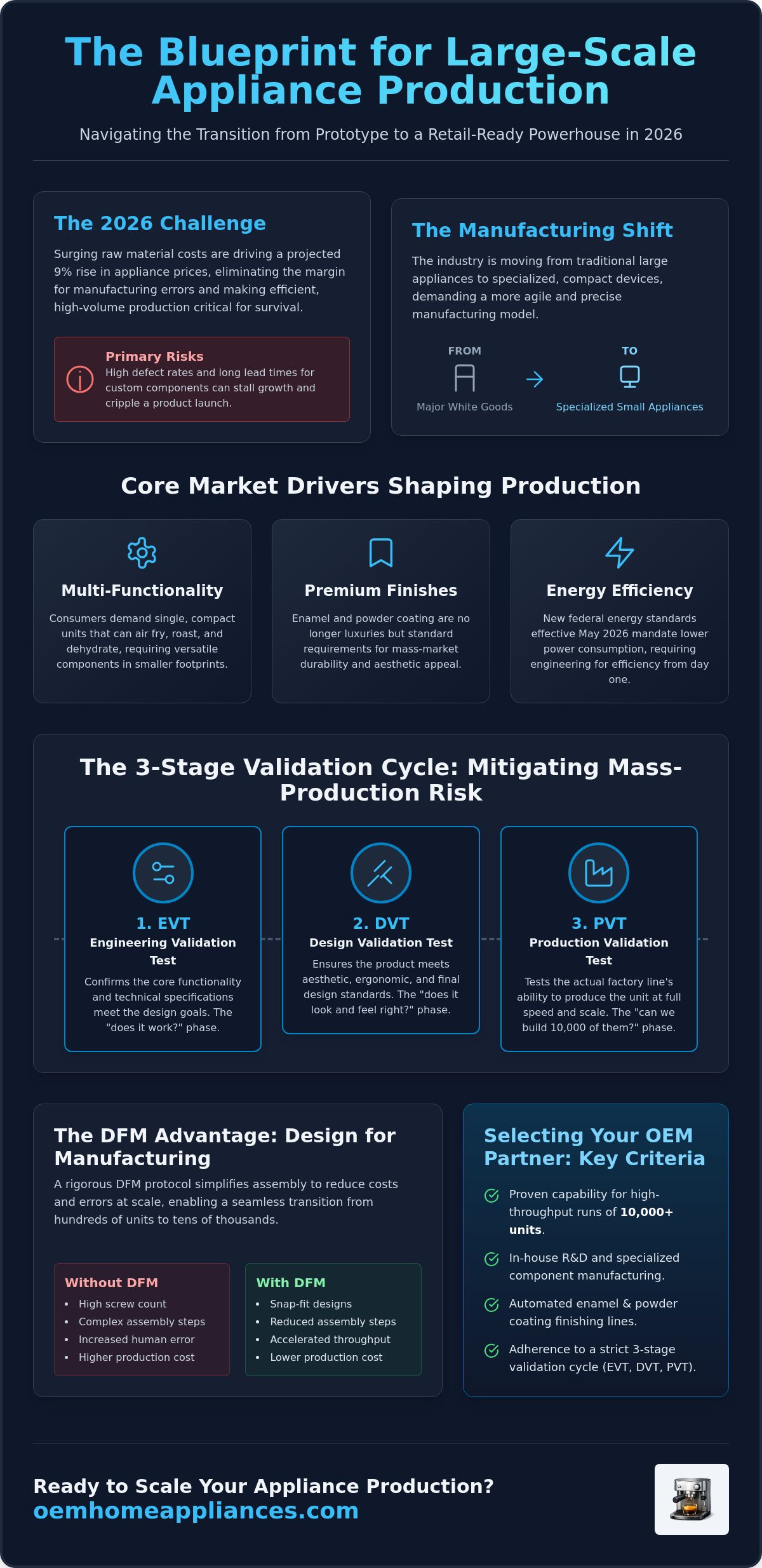
Large Scale Appliance Production: A 2026 Strategic Case Study on Scaling Global Brands

With appliance prices rising by nearly 9% in 2026 due to surging raw material costs, the margin for manufacturing error has effectively disappeared. Successfully navigating large scale appliance production requires more than just increasing floor space; it demands a fundamental shift in how you integrate R&D with high-volume output. You've likely seen how easily a successful prototype can stumble when faced with the realities of mass assembly lines. High defect rates and long lead times for custom metal components often stall growth just as a brand is ready to capture global retail interest.
It's a common frustration for procurement officers who need a partner capable of both technical precision and industrial scale. This article outlines the operational strategies required to transition your kitchen appliance line from a niche offering to a retail-ready powerhouse. You'll discover a clear roadmap for scaling production while maintaining the integrity of specialized finishes like enamel and powder coating. We provide a deep dive into how modular R&D ensures your air fryers, kettles, and coffee machines meet rigorous 2026 energy standards without compromising on build quality or delivery timelines.
Table of Contents
The Landscape of Large-Scale Appliance Production in 2026
Large scale appliance production in 2026 is defined by a shift from manual assembly to high-throughput, automated manufacturing. We characterize this transition by production runs exceeding 10,000 units per cycle. This isn't just a change in volume. It's a fundamental restructuring of the supply chain. Global brands are moving away from traditional "Major White Goods" like oversized refrigerators. Instead, they're focusing on "Specialized Small Appliances" that cater to modern, compact lifestyles. This shift requires a manufacturing partner that provides a stable industrial backbone while remaining flexible enough to adapt to rapid design changes.
Success in 2026 requires a "Resilience First" manufacturing model. With raw material prices for aluminum and plastics surging in the first half of the year, manufacturers can't rely on fragile logistics. You need a partner that acts as a dependable engine for your growth. Modern mass production methods now integrate real-time inventory management with high-speed assembly. This ensures that even as tariffs on steel and copper fluctuate, your output remains stable. A resilient model prioritizes stability and long-term trust, ensuring your brand stays on retail shelves regardless of market volatility.
Market Trends Shaping High-Volume Manufacturing
The demand for multi-functional portable cooking equipment has spiked in urban markets. Consumers want a single unit that can air fry, roast, and dehydrate. This trend forces large scale appliance production to incorporate more versatile components within smaller footprints. Additionally, there's a clear preference for premium finishes. Enamel and powder coating are no longer reserved for luxury items. They're now standard requirements for mass-market roaster ovens and kettles. These finishes provide the durability and aesthetic appeal that 2026 consumers expect. Sustainability also plays a critical role. New federal energy efficiency standards, effective as of May 2026, mean every unit must be engineered for lower power consumption from the design phase.
Small Appliances vs. Major Appliances: The Production Divide
Many assume that smaller appliances are simpler to produce. The opposite is often true. Manufacturing compact kitchen electronics requires extreme precision in small motors and heating elements. There's less room for error inside a rice cooker than inside a full-sized dishwasher. High-volume assembly for compact devices demands sophisticated R&D to manage heat dissipation and electrical safety in tight spaces. Specialized kitchen appliance development often requires more intense prototyping cycles than standard white goods. You must validate the design for both performance and manufacturability to avoid high defect rates during a massive production run. Precision at scale is the only way to maintain brand reputation.
Engineering for Scale: The Transition from Prototype to Mass Production
Transitioning a kitchen appliance from a functional prototype to large scale appliance production requires a rigorous Design for Manufacturing (DFM) protocol. It's a process of simplification. Our engineers analyze every component to reduce assembly steps without compromising the product's core functionality. By utilizing snap-fit designs or reducing the total screw count, we minimize the potential for human error and accelerate the throughput of the assembly line. This efficiency is what allows a brand to move from hundreds of units to tens of thousands without a linear increase in production costs.
Risk mitigation during this transition relies on a strict 3-stage validation cycle. We begin with Engineering Validation (EVT) to confirm the technical specifications. This is followed by Design Validation (DVT) to ensure the aesthetic and ergonomic standards are met. The final stage, Production Validation (PVT), tests the actual factory line's ability to produce the unit at full speed. Skipping these steps often leads to mass-production failures that can bankrupt a product launch. High-quality tooling and die optimization further stabilize this process. Investing in precision steel dies ensures that every metal component for your roaster ovens or BBQ grills remains consistent over hundreds of thousands of cycles.
Scaling IoT-enabled appliances like smart air fryers or coffee machines introduces a digital layer to the factory floor. We integrate secure firmware flashing stations directly into the assembly line. This ensures that every smart feature is tested and verified before the unit is boxed. If you want to streamline your transition to mass manufacturing, our team offers comprehensive private label manufacturing services tailored to your brand's specific needs.
The Role of R&D in Large-Scale Success
Success starts long before the assembly line moves. Strategic product design for kitchen appliances dictates how easily a concept can be scaled. Material selection is critical here. We balance the need for premium brand standards with the realities of cost-efficiency. For high-wattage cooking devices, R&D focuses heavily on technical solutions for thermal management. We use advanced simulations to ensure that compact housings don't overheat during prolonged use, protecting both the consumer and your brand reputation.
Automation and Robotics in Small Appliance Assembly
Precision is non-negotiable in high-volume rice cooker and blender lines. We use robotics for delicate tasks like precision soldering and component placement. These automated quality assurance systems monitor every unit in real-time, checking for electrical continuity and sensor accuracy. This integration significantly reduces Final Defect Rates (FDR) compared to manual inspection. Synchronous Assembly is the gold standard for 2026 appliance factories, where every robotic and manual station operates in perfect temporal alignment to eliminate bottlenecks.
Case Study: Scaling Custom Roaster Oven Production for Global Retail
Scaling a hero product requires a clinical analysis of market-specific demands. We initiated this case study by auditing the roaster oven requirements for both North American and European retail sectors. This first phase focused on reconciling different voltage requirements and safety certifications into a single, modular chassis design. Once the design was finalized, we managed the transition from prototype to mass production by reconfiguring our assembly lines for high-throughput output. This wasn't a simple duplication of the prototype process. It involved creating specialized jigs and fixtures that allowed for the simultaneous assembly of multiple sub-systems.
Phase three of this case study involved the integration of specialized metal components. Roaster ovens rely on high-grade steel for their pans and outer shells. We secured long-term contracts for raw materials to insulate the brand from the 2026 price surges in the metals market. By moving to large scale appliance production, the brand achieved a 40% reduction in per-unit costs. These savings didn't come from cutting corners. They were the direct result of bulk material procurement and the elimination of manual finishing bottlenecks through automated enamel lines.
Overcoming Scaling Hurdles for Roaster Ovens
Maintaining heat distribution consistency across 50,000+ units is the primary challenge in roaster manufacturing. Even a minor deviation in heating element placement can lead to uneven cooking and brand-damaging reviews. We implemented automated sensor testing at three points on the assembly line to verify thermal performance before final packaging. This ensures that custom roaster oven manufacturing standards remain high even at peak volume. Logistics also play a vital role. We optimized the packaging design to increase pallet density by 15%, reducing the total number of containers required for global shipping.
Supply Chain Integration for Portable Cooking
Successful large scale appliance production depends on a robust supply chain for critical components. We source high-grade heating elements from verified tier-one suppliers to ensure continuous production runs without quality dips. To combat 2026's supply chain volatility, we maintain a "Buffer Stock" of essential electronic controllers and sensors. This 60-day reserve acts as a shock absorber against shipping delays. By centralizing our manufacturing in hubs like Malaysia, we offer competitive lead times and direct access to major shipping lanes. This strategic positioning allows your brand to respond quickly to sudden shifts in retail demand.
Quality Assurance and Specialized Finishing at Scale
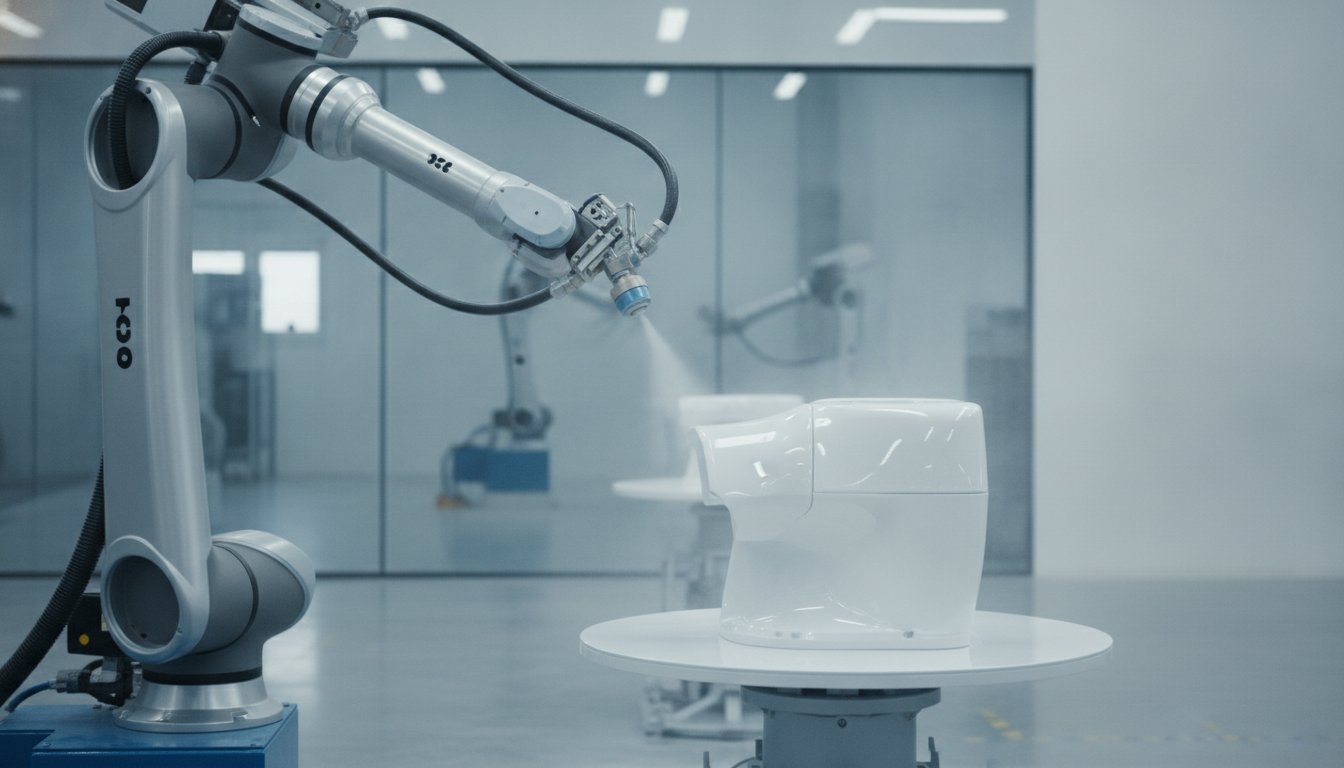
Manual finishing is the primary bottleneck in large scale appliance production. While hand-application works for niche prototypes, it lacks the repeatability required for runs of 10,000 units or more. Inconsistent coating thickness leads to localized heat stress, which eventually causes the finish to crack or peel. We solve this by utilizing fully automated enamel coating lines. These systems use electrostatic application to ensure a uniform micrometer-level coat across every surface. This level of precision is vital for roaster ovens and BBQ grills that must withstand extreme thermal cycling over years of use.
Powder coating for metal components follows a similarly rigorous path. We subject mass-produced parts to salt spray and impact testing to verify the durability of the bond. When you're shipping 100,000 units globally, regulatory compliance isn't just a checklist; it's a massive logistical operation. We embed testing protocols for UL, CE, and FDA standards directly into the manufacturing flow. This ensures that every batch meets international safety and energy efficiency requirements without slowing down the assembly line. If you need a partner with the infrastructure for enamel-coated product manufacturing, we provide the industrial capacity to maintain these standards at any volume.
Technical Solutions for Metal Finishing
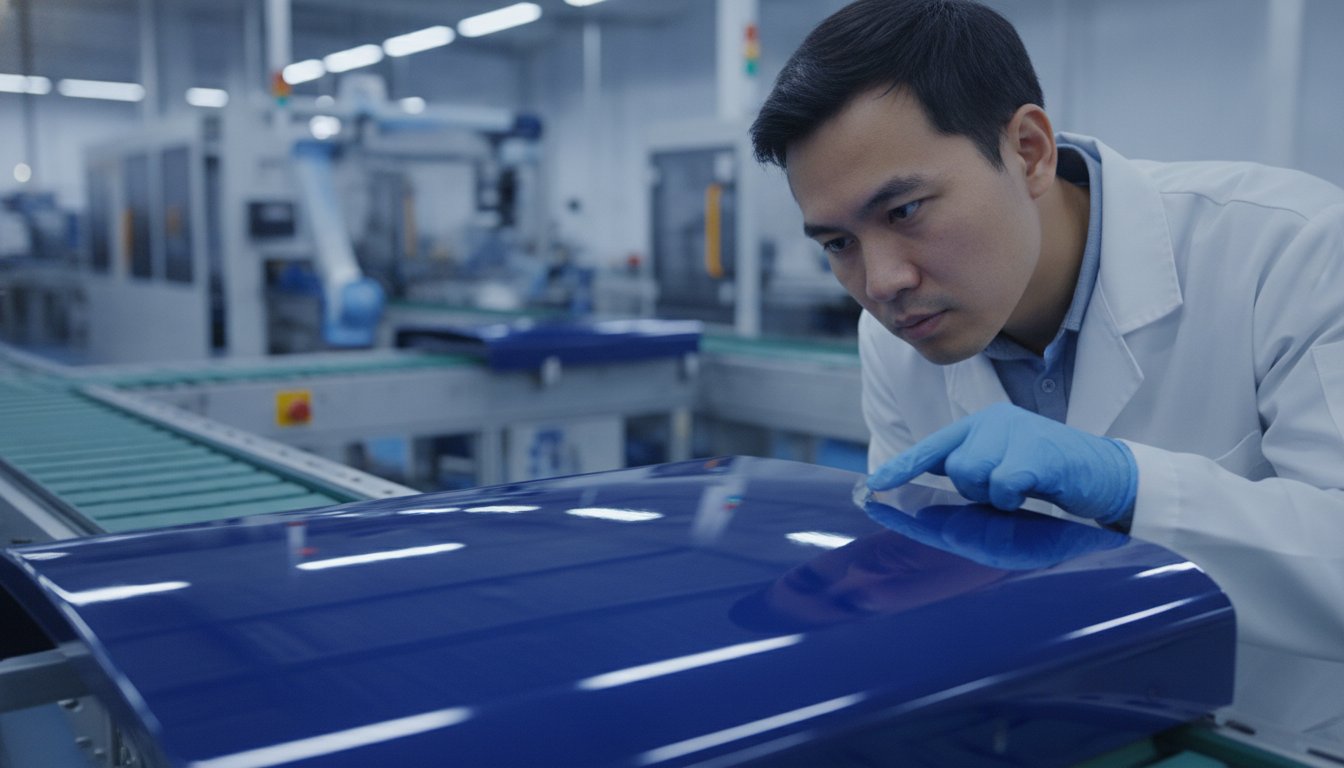
Finishing R&D is a core pillar of specialized kitchen appliance development. It's where the science of material science meets industrial throughput. We focus heavily on enamel adhesion within high-volume industrial kilns. By precisely controlling the temperature ramp-up and cool-down phases, we ensure the enamel bonds perfectly to the metal substrate. To catch even the smallest imperfections, we implement quality gates equipped with AI-driven visual inspection. These computer vision systems identify surface defects that are invisible to the human eye, ensuring that only flawless products reach the packaging stage.
Testing Protocols for Global Brands
Testing must be as scalable as production itself. We don't just test for out-of-the-box functionality; we test for long-term reliability. Our life-cycle testing protocols simulate five years of heavy kitchen use in just 48 hours. This involves thousands of door-open cycles for ovens and continuous operation tests for blenders. For high-capacity rice cookers, we stress test heating elements by running them at peak wattage for extended durations to identify potential failure points before they reach the consumer. AQL 0.65 is the industry benchmark for premium appliance production. This strict Acceptance Quality Limit ensures that your brand reputation remains protected even during the most aggressive scaling phases.
Selecting Your Large-Scale Manufacturing Partner
Choosing a partner for large scale appliance production is a strategic decision that dictates your brand's trajectory for years. You shouldn't settle for a simple assembler. A true partner acts as an engineering extension of your own team. When evaluating potential factories, look closely at their R&D-to-production ratio. Assemblers merely follow instructions; engineers optimize your product for better yield and lower defect rates. This distinction becomes critical when you're scaling to 10,000+ units, where a minor design inefficiency can lead to massive financial losses across the production run.
Specialized component capabilities are another non-negotiable audit point. Does the factory handle its own enamel coating or powder coating in-house? Outsourcing these critical finishing steps adds layers of risk to your supply chain and complicates quality control. In-house finishing ensures that the durability standards we discussed in previous sections are met without delay. Additionally, assess their financial stability and current investment in 2026 automation technology. A partner that isn't investing in robotic assembly and AI-driven inspection won't be able to keep pace with global retail demands. Review their history with strategic guide to selecting a private label kitchen appliance manufacturer models to ensure they understand the nuances of brand empowerment.
The 5-Step OEM Selection Framework
Step 1: Technical capability audit. Verify their R&D depth and prototyping cycles. Ensure they can transition a concept to a retail-ready unit efficiently.
Step 2: Capacity and scalability verification. Confirm their monthly output can handle your peak season demands without compromising lead times.
Step 3: Quality Management System (QMS) inspection. Look for AQL 0.65 benchmarks and integrated testing stations on the assembly line.
Step 4: Supply chain transparency. Audit their material sourcing for steel, aluminum, and electronic components to ensure resilience against market volatility.
Step 5: Communication and project management. Ensure their team aligns with your reporting needs and provides frictionless engagement throughout the production cycle.
Why Partnership Trumps Simple Procurement
Procurement is a transaction; partnership is a growth strategy. A dedicated manufacturing engine acts as a silent partner that exists to empower your brand's success. This relationship offers long-term cost benefits that go far beyond the initial per-unit price. By working with a seasoned industry veteran, you gain access to a global supply chain and industrial strength that would be impossible to build alone. It's about creating a dependable backbone for your business that allows you to focus on marketing and distribution. Scale your appliance brand with our expert R&D and production services.
Future-Proof Your Brand for Global Scale
Navigating the complexities of large scale appliance production in 2026 requires more than just industrial capacity; it demands a technical partner that integrates R&D with high-volume execution. Success hinges on a robust Design for Manufacturing protocol and automated finishing systems that ensure consistency across every unit. By prioritizing supply chain resilience and modular engineering, you can protect your margins against fluctuating material costs while meeting the world's strictest energy standards. Our dedicated B2B OEM/ODM services provide the stability and precision you need to transition from a single successful concept to a global retail presence.
We invite you to partner with oemhomeappliances for your next high-volume production run. Benefit from our specialized enamel and powder coating R&D and a global supply chain designed for industrial strength. We act as the silent engine behind your brand, providing the meticulous execution required for long-term growth. Let's build a dependable manufacturing foundation that empowers your business to lead the market with confidence.
Frequently Asked Questions
What is the typical MOQ for large scale appliance production?
Minimum Order Quantities for high-volume manufacturing typically start at 1,000 to 3,000 units per run, depending on the appliance's technical complexity. These levels allow the factory to amortize the setup costs of automated assembly lines and specialized tooling. Moving toward 10,000 units per cycle often unlocks the greatest efficiencies in material procurement and logistics.
How do I ensure quality remains consistent when scaling from 1,000 to 100,000 units?
Consistency at scale requires a shift from manual inspection to integrated, automated quality assurance systems. We use AI-driven visual inspection and automated testing stations at critical quality gates to identify defects in real-time. This methodical approach ensures that every unit meets the same rigorous standards, whether it's the first or the hundred-thousandth item off the line.
Can custom designs be effectively scaled in a private label model?
Custom designs are highly scalable when you apply Design for Manufacturing (DFM) principles during the initial R&D phase. This ensures that your unique product features are compatible with high-speed large scale appliance production equipment. By standardizing internal components while customizing the exterior housing and finishes, you maintain brand exclusivity without sacrificing manufacturing throughput.
What are the advantages of manufacturing appliances in Malaysia vs. China in 2026?
Malaysia provides a stable trade environment and a resilient supply chain that helps mitigate the impact of global tariff fluctuations. In 2026, the region's focus on high-tech manufacturing makes it an ideal hub for specialized kitchen electronics. This location offers predictable lead times and direct access to major global shipping lanes, providing a dependable alternative to more volatile markets.
How long does the transition from prototype to mass production usually take?
The transition typically takes 3 to 6 months to complete a full three-stage validation cycle. This period covers Engineering Validation, Design Validation, and Production Validation to ensure the factory line is fully optimized. A methodical timeline prevents costly mass-production failures and ensures that the final product meets all safety and performance specifications before a global launch.
What specialized finishes are available for high-volume kitchen appliances?
We provide high-durability enamel coating and precision powder coating for a variety of metal components. Enamel is the gold standard for heat-intensive products like roaster ovens and BBQ grills due to its exceptional heat resistance. Powder coating offers a cost-effective, durable finish for air fryers and kettles, allowing for a wide range of custom colors and textures at scale.
How does large-scale production impact the per-unit cost of roaster ovens?
Large scale appliance production reduces per-unit costs by maximizing material utilization and leveraging automated finishing lines. Bulk procurement of high-grade steel and electronic components shields the brand from market price surges. These operational efficiencies, combined with reduced manual labor hours, allow for significantly better retail margins compared to low-volume manufacturing models.
What certifications should I look for in a large-scale appliance manufacturer?
Look for partners that maintain current UL, CE, and FDA certifications to ensure global market access. It's also critical to verify that the manufacturer complies with the latest 2026 energy efficiency standards for small appliances. These certifications demonstrate a commitment to safety and quality, ensuring your products are ready for immediate distribution in major international retail chains.

Comments