Strategic Guide to Selecting a Private Label Kitchen Appliance Manufacturer
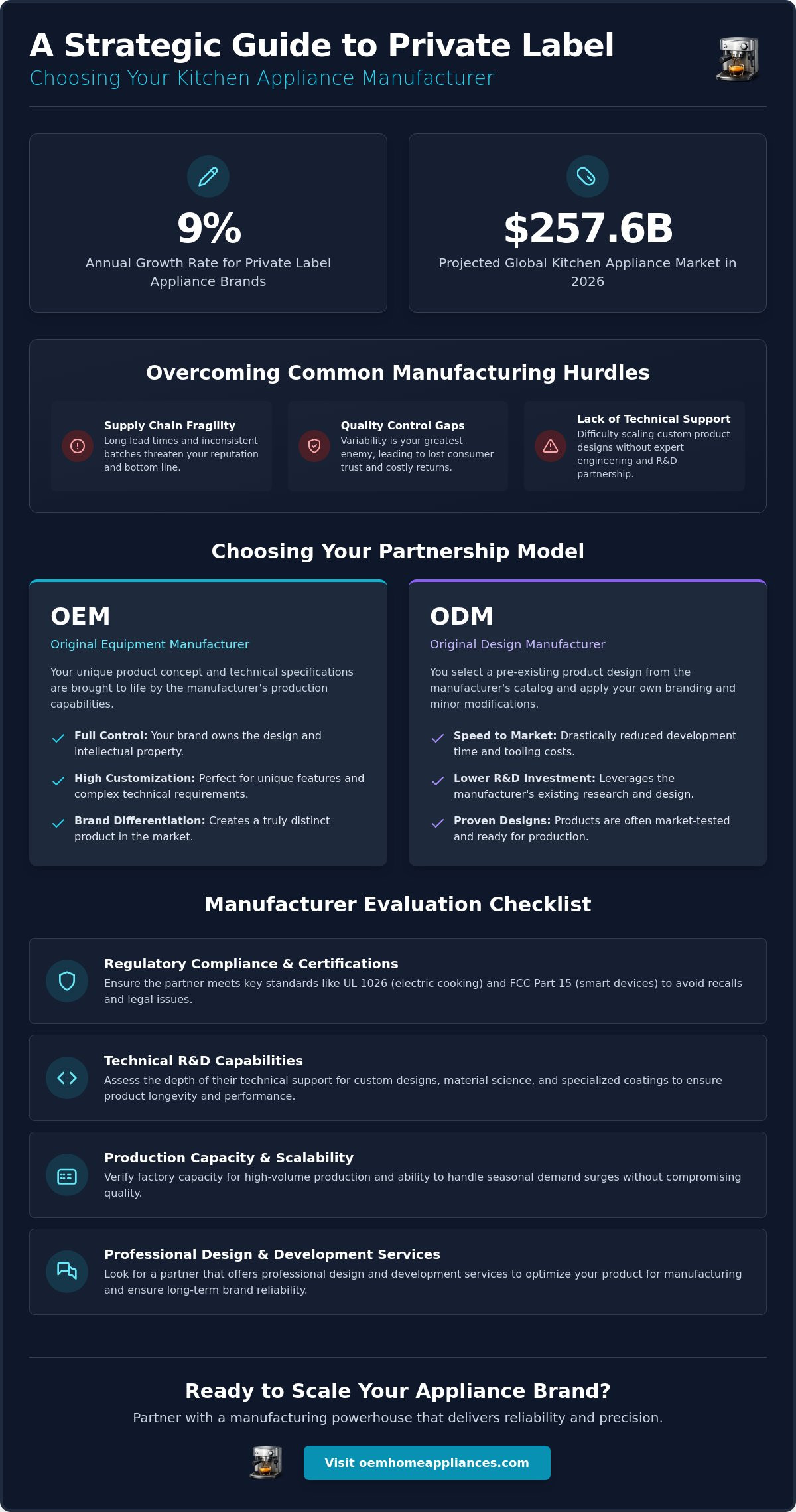
With private label appliance brands seeing a 9% growth rate and the global kitchen appliance market projected to reach $257.60 billion in 2026, the opportunity for brand expansion is immense. However, selecting the right private label kitchen appliance manufacturer is the single most critical decision for your brand's longevity. A partnership built on technical synergy and manufacturing precision separates market leaders from those struggling with inconsistent batches. You need a partner that handles high volume production with custom technical specifications while maintaining rigorous quality control.
You've likely faced the frustration of long lead times and a lack of technical support for custom product development. It's difficult to scale when supply chain fragility threatens your reputation and bottom line. This guide provides the strategic framework to identify, evaluate, and partner with a manufacturing powerhouse that prioritizes reliability. You'll learn how to move beyond simple factory capacity to find a partner that acts as a dependable backbone for your business.
We'll break down the essential criteria for evaluation, from verifying compliance with UL 1026 and FCC Part 15 standards to assessing technical support for complex designs. This overview prepares you to secure a manufacturing relationship that delivers consistent quality and operational stability.
Table of Contents
Understanding the Role of a Private Label Kitchen Appliance Manufacturer
Private label manufacturing in the kitchen sector is the process where a brand owner or retailer commissions a third-party factory to produce goods under their own brand name. It's a strategic shift from simple procurement to a deep industrial partnership. Selecting a private label kitchen appliance manufacturer allows you to leverage existing factory infrastructure while maintaining control over brand identity and pricing. This model bridges the gap between a product concept and large-scale market availability without the overhead of owning a factory.
The transition from brand conceptualization to industrial production requires more than just a factory floor. It demands a sophisticated Original Equipment Manufacturer (OEM) that understands the nuances of material science and precision engineering. Established brands prioritize these partnerships because in-house production involves prohibitive capital costs. Building a dedicated facility for specialized appliances like induction cooktops or complex air fryers often distracts from core marketing and distribution goals. Partnering with an expert ensures that your resources stay focused on growth while the technical complexities remain in expert hands.
A professional partnership ensures brand consistency across every batch. When you scale, variability is your greatest enemy; it's the fastest way to lose consumer trust. A dedicated private label kitchen appliance manufacturer implements rigorous quality control protocols that internal teams might lack. This stability is what allows a brand to move from a local niche to a national retail presence. You aren't just buying products; you're securing a dependable backbone for your entire supply chain.
The Value of a Technical Manufacturing Partner
Technical partners bring deep expertise in navigating complex global safety and quality certifications. For instance, ensuring compliance with UL 1026 for electric cooking appliances or FCC Part 15 for smart devices requires specialized lab testing and documentation. By utilizing established production workflows, you significantly reduce time-to-market. You also gain access to proprietary manufacturing techniques and high-precision machinery that would take years to develop independently. This expertise protects your brand from the risks of regulatory non-compliance and product recalls.
Key Categories in Private Label Kitchenware
The scope of private labeling covers several high-growth categories that cater to diverse consumer needs. Portable cooking equipment like kettles and blenders offers a low barrier to entry for new brands. Specialized heating appliances, such as roaster ovens and rice cookers, cater to specific culinary niches requiring precise temperature control. Additionally, high-demand electronics like air fryers and coffee machines remain top priorities for brands looking to capture the current market interest in healthy, convenient home cooking. Each category requires a specific set of technical capabilities to ensure long-term durability.
Technical Excellence: From Core Production to Specialized Coatings
Manufacturing excellence is defined by the precision of individual components. A professional private label kitchen appliance manufacturer understands that material science is the foundation of product longevity. High-quality appliances require metals and polymers that withstand thermal stress, repeated mechanical use, and chemical exposure from cleaning agents. By prioritizing the structural integrity of the base materials, you ensure that your brand is associated with reliability rather than frequent returns.
High-volume production of core appliances, such as rice cookers and air fryers, requires a methodical approach to scaling. Consistency across ten thousand units is significantly more challenging than producing a single prototype. You need a partner that utilizes automated assembly lines and standardized testing phases to eliminate human error. This level of industrial precision allows for functional customization, such as modified airflow designs in air fryers or enhanced heating elements in rice cookers, without compromising the overall manufacturing speed.
Quality control protocols for high-precision metal components must be rigorous. Every housing, bracket, and internal frame should undergo dimensional inspection to ensure perfect fitment. When evaluating a private label kitchen appliance manufacturer, prioritize those with in-house metal fabrication and finishing capabilities. This vertical integration reduces supply chain risks and ensures that the technical specifications of your custom components are met with absolute accuracy.
Enamel-Coated Products and Metal Components
Industrial enamel coating provides a superior level of heat resistance and hygiene that standard finishes cannot match. In roaster ovens and premium cookware, enamel creates a non-porous surface that resists bacterial growth and withstands extreme temperatures. The process involves fusing glass particles to a metal substrate at high heat, creating a durable bond. This specialized application process ensures that the coating does not chip or degrade, maintaining the appliance's performance and aesthetic appeal over years of heavy use.
Powder-Coated Metal Components for Modern Aesthetics
Powder coating offers a versatile solution for brands looking to achieve specific colorways and premium finishes. Unlike liquid paint, powder coating is applied electrostatically and cured under heat to create a hard, protective layer. This finish protects metal housings from corrosion and daily wear while offering significant environmental advantages, as it produces minimal volatile organic compounds (VOCs). It's an ideal choice for modern kitchen appliances where both durability and brand-specific aesthetics are critical for market differentiation.
OEM vs. ODM: Selecting the Optimal Partnership Model
The choice between OEM and ODM determines your speed to market and the level of technical differentiation your brand achieves. An experienced private label kitchen appliance manufacturer typically offers both models to accommodate different growth stages. Original Equipment Manufacturing (OEM) is a bespoke process where you provide the blueprints and the factory provides the industrial capacity. In contrast, Original Design Manufacturing (ODM) involves selecting from the manufacturer's pre-existing catalog of designs. This model is built for efficiency and proven performance.
Aligning your R&D budget with these models is vital for long-term sustainability. OEM requires significant upfront investment in tooling, prototyping, and engineering. ODM allows you to skip these costs by leveraging designs that have already passed safety certifications like UL 1026. Many successful brands now adopt a hybrid approach. They take an existing air fryer or rice cooker platform and request specific aesthetic or functional modifications. This balances uniqueness with manufacturing stability while keeping development costs manageable.
Your decision should reflect your brand's core value proposition. If your brand is built on a proprietary heating technology, OEM is non-negotiable. If your goal is to quickly capture a share of the $257.60 billion global kitchen appliance market, ODM provides the necessary agility. A versatile private label kitchen appliance manufacturer will help you navigate these trade-offs to ensure your product line remains both innovative and profitable.
When to Choose OEM Manufacturing
OEM is the ideal path for brands with proprietary designs or unique technical requirements that aren't available in the general market. It allows you to maximize control over every component, from the grade of stainless steel to the specific enamel coating used on internal components. By utilizing kitchenware private label services for bespoke launches, you ensure that your product is technically distinct from competitors. This model protects your intellectual property and allows for deep integration of custom software or smart features.
The Advantages of the ODM Approach
The ODM approach is designed for rapid market entry and reduced engineering risk. By utilizing factory-tested designs, you eliminate the lengthy R&D phases that often delay product launches. This model significantly lowers the initial investment required for new product line expansions, making it perfect for testing new categories like portable grills or coffee machines. ODM allows you to focus your brand's resources on marketing and distribution rather than the complexities of industrial engineering. It provides a frictionless path to scaling your catalog with reliable, high-performing appliances.
Critical Evaluation Criteria for Appliance Manufacturing Partners
Selecting a private label kitchen appliance manufacturer requires an audit of their operational resilience. It isn't enough to review a catalog; you must verify their ability to handle high-volume, seasonal demand. Retail cycles often peak in the fourth quarter, requiring factories that can scale production without sacrificing quality. A partner with robust R&D and prototyping capabilities allows you to troubleshoot technical hurdles before mass production begins. This proactive approach prevents the inconsistent quality across batches that plagues many growing brands.
Strategic sourcing also involves evaluating a manufacturer's third-party audit history and internal quality assurance procedures. Reliable partners maintain transparent records of their production standards and material sourcing. When you compare manufacturing hubs, consider the logistical advantages of different regions. Evaluating these factors ensures your supply chain remains agile and cost-effective. Consult with our technical team to review how our manufacturing infrastructure supports your specific scaling requirements.
Regional Advantages: Malaysia vs. China
Analyzing trade tariffs is essential for calculating landing costs and protecting your margins. Malaysia has emerged as a critical alternative to traditional hubs, offering unique advantages in supply chain stability. Comparing lead times and regulatory environments between these regions helps you mitigate geopolitical risks. For a deeper analysis of these sourcing dynamics, consult the Malaysia vs China appliance manufacturing guide for a detailed breakdown of 2026 strategic sourcing.
Quality Standards and Certifications
Compliance with international safety standards is the foundation of market entry. Ensure your partner adheres to the latest regulations, such as the UL 1026 6th Edition for electric cooking appliances, approved in June 2026. Internal testing labs play a vital role in maintaining your brand reputation by catching defects before they leave the factory floor. Factory audits are non-negotiable for premium brands; they provide the necessary verification that a private label kitchen appliance manufacturer maintains high-precision standards. These certifications, alongside 16 CFR Part 1263 for battery safety, ensure your products are ready for global distribution.
Scaling Your Brand with oemhomeappliances (Keiteq)
Keiteq serves as a dedicated private label kitchen appliance manufacturer that prioritizes technical precision and industrial scalability. We provide a comprehensive product design and development framework tailored for global brands looking to expand their footprint. Our focus remains exclusively on B2B success; we don't compete with our clients in the retail space. This ensures that our interests are fully aligned with your growth. Whether you require specialized roaster ovens or high-demand air fryers, our facility is equipped to handle complex technical specifications with meticulous execution and quiet authority.
Our expertise extends beyond basic assembly to advanced technical solutions for enamel and powder-coated components. These specialized finishes are managed in-house to ensure the highest levels of hygiene and durability. By maintaining vertical integration, we eliminate the common risks associated with third-party finishing and provide a seamless path to market for premium kitchenware. This control over the entire production cycle allows us to offer the flexibility and precision that elite brands demand in a competitive landscape.
Streamlined Manufacturing Workflows
We manage the entire lifecycle of your product, from initial prototyping to mass production and global logistics. As a "Trusted Expert Facilitator," we remove the friction often found in international production cycles. Our team provides the necessary support for those looking to outsource appliance production at scale while maintaining rigorous quality control. This methodical workflow ensures that your brand avoids the pitfalls of long lead times and inconsistent product quality that can derail a successful launch. We act as the dependable backbone of your supply chain.
The Keiteq Advantage for Established Brands
Established brands benefit from our industrial-scale production capabilities and deep industry expertise. We offer tailored solutions for custom roaster oven manufacturing, allowing you to capture market share with products that meet specific consumer needs. Our facility supports the development of portable cooking equipment, blenders, and kettles with the same level of precision. Our role as your private label kitchen appliance manufacturer is to empower your brand with a reliable manufacturing engine that adapts to your needs. Contact our team today to discuss your next private label project and secure a partnership built on long-term trust and technical excellence.
Securing Your Brand's Industrial Future
Building a market-leading appliance brand requires more than just a vision; it demands an uncompromising commitment to manufacturing precision. You've seen how the right partnership model, whether OEM or ODM, balances innovation with speed to market. Success in the competitive kitchen sector depends on technical excellence, from the durability of enamel coatings to the reliability of high-volume assembly lines. Selecting a private label kitchen appliance manufacturer that understands these nuances is the foundation of your long-term scalability.
Keiteq provides the industrial strength and technical expertise necessary to transform your product concepts into global successes. We offer specialized enamel and powder coating expertise alongside a full-service product design and development framework. Our facility maintains the high-volume production capacity required to support established global brands without compromising on quality standards. Partner with oemhomeappliances for your next private label project and leverage a manufacturing engine built for your success. Your brand is ready for the next level of industrial precision.
Frequently Asked Questions
What is the difference between a private label and a white label appliance?
Private label products are manufactured for exclusive sale by a specific brand and often involve custom specifications or unique design elements. In contrast, white label products are generic, mass-produced items sold to multiple retailers who simply add their own logo. Private labeling provides greater market differentiation and control over the final product's quality and features.
How do I protect my intellectual property when working with an OEM manufacturer?
Protecting your intellectual property requires a multi-layered legal and operational approach. You should start with comprehensive Non-Disclosure Agreements (NDAs) and manufacturing contracts that clearly define ownership of designs, blueprints, and specialized tooling. It's also vital to register your trademarks and patents in the manufacturer's country to ensure local legal recourse if a dispute arises.
What are the typical MOQs for private label kitchen appliances?
Minimum Order Quantities (MOQs) for a private label kitchen appliance manufacturer typically range from 500 to 1,000 units per SKU. Smaller, less complex items like blenders or kettles may require higher volumes to maintain cost-efficiency. Larger appliances, such as air fryers or roaster ovens, might allow for lower initial runs depending on the factory's production schedule and material availability.
Can I customize the technical features of an existing appliance design?
You can customize the technical features of existing designs through a hybrid ODM model. This allows you to modify specific components like heating elements, airflow patterns, or digital control interfaces to differentiate your product. This approach is highly efficient because it leverages a factory-tested base platform while allowing for brand-specific functional improvements that meet your target audience's needs.
How long does the prototyping process take for a new kitchen appliance?
The prototyping process generally takes between 4 and 12 weeks from the initial design approval. The exact timeline depends on the complexity of the appliance and whether specialized molds or custom electronic components are required. This phase is critical for testing functional performance and ensuring the product meets all safety requirements before you commit to high-volume mass production.
Why is enamel coating preferred for certain cooking appliances?
Enamel coating is preferred because it provides a non-porous, hygienic surface that is exceptionally resistant to high temperatures and chemical corrosion. It's an ideal finish for roaster ovens and premium cookware where food safety and durability are paramount. The fused glass-to-metal bond ensures the surface doesn't peel or leach chemicals, maintaining the appliance's aesthetic and functional integrity over time.
How does sourcing from Malaysia compare to China for appliance brands?
Malaysia offers significant advantages in trade tariff mitigation and supply chain stability, particularly for brands targeting North American or European markets. While China provides a massive component ecosystem, Malaysia serves as a reliable alternative for reducing landing costs and logistical risks. Many brands find that Malaysian factories offer a more partnership-oriented approach with a high level of technical expertise.
What certifications should I look for in a kitchen appliance factory?
Look for a private label kitchen appliance manufacturer that holds international safety certifications such as UL, CE, and GS to ensure global market access. The factory should also maintain ISO 9001 for quality management and demonstrate compliance with specific regional regulations like FCC Part 15 for smart devices. These certifications verify that the facility adheres to rigorous safety, environmental, and operational standards.


Comments