How to Utilize Kitchenware Private Label Services to Scale Your Appliance Brand in 2026
Updated: Jun 19
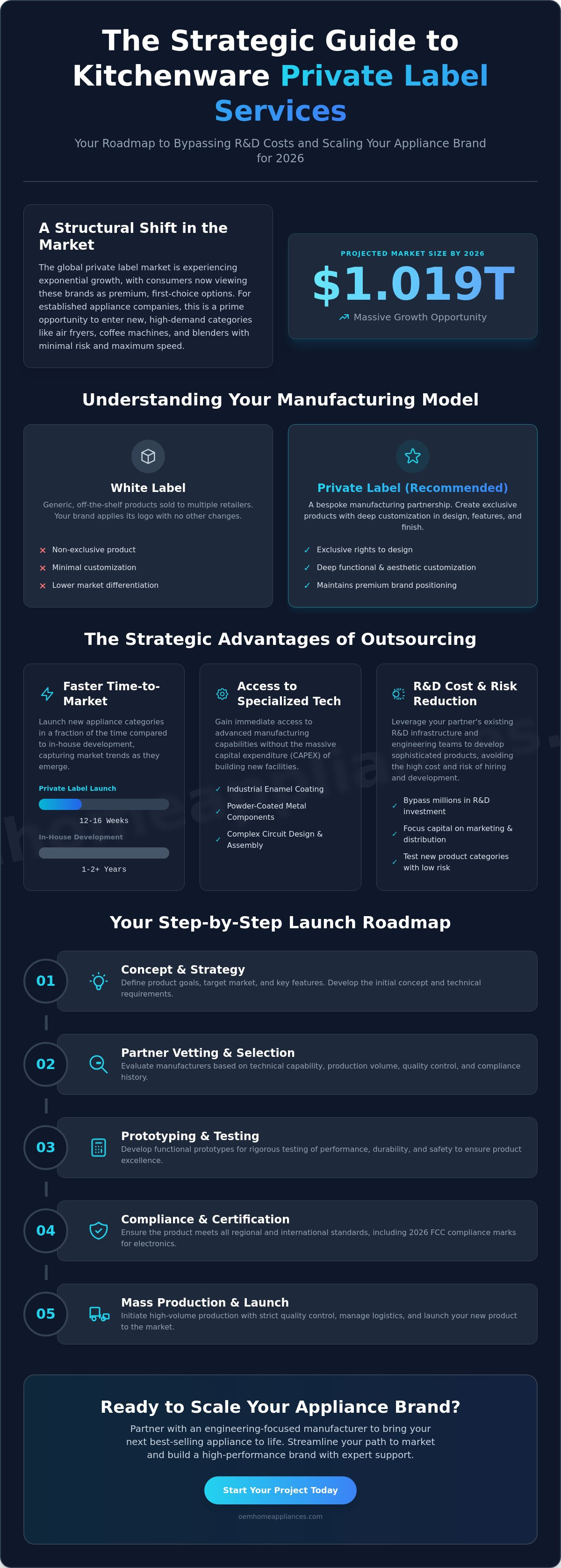
With the global private label market projected to reach $1,019.23 billion in 2026, the industry is seeing a structural shift where consumers prioritize these brands as their first choice. For established appliance companies, this growth represents a massive opportunity to capture market share without the traditional overhead of internal development. However, the path to expansion is often blocked by high R&D costs and the difficulty of finding manufacturers with specialized capabilities like enamel or powder coating. Utilizing professional kitchenware private label services is no longer just about adding a logo to a generic product; it's a strategic engineering partnership that allows you to scale rapidly while maintaining elite quality standards.
You likely recognize that maintaining consistency across a global supply chain is becoming increasingly complex as technical regulations evolve. This guide provides a comprehensive roadmap for navigating these hurdles, from selecting a manufacturer with proven industrial strength to achieving mass production. We'll show you how to streamline your path to market for new categories like air fryers or coffee machines while ensuring compliance with 2026 standards. This overview covers the essential steps of partner vetting, technical specifications, and the logistics required to build a scalable, high-performance appliance brand.
Key Takeaways
Learn why kitchenware private label services are the most efficient way for established brands to bypass high R&D costs and enter new appliance categories in 2026.
Identify the critical technical markers to look for when vetting manufacturers, including R&D infrastructure for complex circuit designs and high-volume production capacity.
Determine whether the OEM or ODM model better suits your business goals by weighing the benefits of bespoke designs against the speed of proven factory designs.
Follow a structured, phase-based roadmap that moves your project from initial concept development through rigorous functional prototyping and safety testing.
Discover how specialized finishing techniques, such as industrial enamel coating and powder-coated metal components, can differentiate your products and create a premium market presence.
Table of Contents
Understanding Kitchenware Private Label Services: A Strategic Entry for Established Brands
How to Evaluate Technical Capabilities in an Appliance Manufacturing Partner
Comparing OEM vs. ODM Models for Kitchenware Private Labeling
The Step-by-Step Roadmap to Launching Private Label Appliances
Maximizing Market Impact with Specialized Coating and Engineering Solutions
Understanding Kitchenware Private Label Services: A Strategic Entry for Established Brands
Established appliance brands face a critical decision in 2026: invest millions in internal manufacturing lines or leverage external expertise to capture emerging trends. Kitchenware private label services offer a collaborative manufacturing model where a specialized factory produces high-end appliances under your brand's name. This isn't just about procurement. It's about strategic alignment. By partnering with an expert manufacturer, you gain the ability to launch sophisticated products without the burden of building new infrastructure from scratch.
The market has shifted significantly. While basic cookware once dominated the sector, the 2026 landscape demands complex small kitchen appliances like multi-functional air fryers, precision coffee machines, and high-performance blenders. Consumers now view private labels as premium alternatives rather than budget fallbacks. This structural change in behavior allows brands to use private labeling as a powerful tool for rapid market testing. You can diversify your portfolio and enter new categories with minimal risk, ensuring your brand stays relevant as consumer preferences evolve toward smart, multi-functional kitchenware.
The Difference Between White Label and Private Label Appliances
Understanding the distinction between these two models is vital for brand positioning. White label products are essentially generic, off-the-shelf items sold to multiple retailers with different branding. In contrast, private label agreements allow for much deeper customization in design, functionality, and aesthetic finish. Established brands utilize this model to maintain their premium market position and ensure product exclusivity. A private label agreement is a bespoke manufacturing arrangement that grants a brand exclusive rights to a specific product design or set of features. It's helpful to understand what private label services are in a broader context to see how they differ from simple contract manufacturing.
Why Established Brands are Outsourcing Appliance Production
Building new production lines requires massive capital expenditure (CAPEX) that can stifle a brand's agility. Outsourcing allows you to bypass these costs while gaining immediate access to specialized manufacturing techniques. Consider these primary advantages:
Access to Specialized Tech: Producing high-quality roaster ovens or kettles often requires specialized enamel-coating or powder-coating capabilities. Most brands don't have these facilities in-house.
Reduced Time-to-Market: Launching a new appliance category through kitchenware private label services typically takes 12 to 16 weeks. Internal development for the same product could take years.
R&D Efficiency: You can tap into existing R&D infrastructure for complex circuit designs in rice cookers or blenders without hiring a new team of engineers.
This approach transforms manufacturing from a logistical hurdle into a competitive advantage. It allows you to focus on marketing and distribution while your partner handles the precision of mass production.
How to Evaluate Technical Capabilities in an Appliance Manufacturing Partner
Evaluating a partner for kitchenware private label services requires looking beyond the assembly line. You need a facility capable of managing the technical complexity of modern small appliances. Unlike simple pots and pans, items like rice cookers and blenders require sophisticated circuit design and rigorous thermal management. In 2026, electronic kitchen appliances must meet updated FCC compliance marks to prevent radio frequency interference. Your partner must prove they can integrate these technical requirements into the initial design phase. High-volume production capacity is equally critical; assess whether the facility can scale to thousands of units without compromising the precision of powder-coated metal components or internal wiring.
Precision in finishing is another technical marker of an elite partner. Look for specialized capabilities such as the production of powder-coated metal components. This finish provides the durability and modern aesthetic required for premium positioning. A manufacturer that manages these processes in-house offers better quality control and more consistent lead times. Finding a partner with these specific capabilities ensures your brand's reputation remains intact during rapid scaling. Explore our comprehensive private label solutions to see how specialized engineering can elevate your next product line.
Assessing R&D and Prototyping Facilities
In-house design and development services are critical for maintaining brand consistency across different product categories. Utilize 3D modeling and functional prototyping to identify potential failures before they reach the mass-production phase. This proactive approach prevents costly errors and ensures that the final product meets your exact specifications. For a deeper look at these processes, read our Strategic Guide to Outsource Appliance Production in 2026. Methodical prototyping is the backbone of a reliable kitchenware private label services partnership.
Certifications and Compliance for Global Markets
Global distribution requires strict adherence to safety standards. Verify that your partner holds current UL, CE, or FCC compliance marks, especially for heat-intensive products like roaster ovens. These certifications are non-negotiable for risk mitigation and market entry. Beyond safety, consider the strategic supply chain considerations regarding environmental and labor standards. You should also ensure the manufacturer can provide mandatory EnergyGuide labeling for the U.S. market. Reviewing factory audit reports is the only way to confirm a partner meets these global expectations before signing a contract.
Comparing OEM vs. ODM Models for Kitchenware Private Labeling
Choosing the right manufacturing model is a pivotal decision when leveraging kitchenware private label services. The choice between OEM and ODM dictates your level of intellectual property ownership, your upfront capital requirements, and your timeline for market entry. Established brands must weigh the desire for proprietary innovation against the need for operational speed. In the appliance sector, this decision often hinges on whether you have a unique engineering breakthrough or simply need to fill a gap in your current product lineup with a reliable, market-tested unit.
The hybrid approach is gaining traction among elite appliance brands in 2026. This model involves taking a manufacturer’s proven internal platform, such as a rice cooker's heating element and circuit board, and applying proprietary aesthetic or functional modifications. You might specify a unique enamel finish or a custom-molded exterior shell. This strategy offers a middle ground, providing a degree of exclusivity without the full R&D costs of a ground-up build. It's a pragmatic way to scale while maintaining a distinct brand identity.
The OEM Path: Full Control and Proprietary Engineering
The OEM (Original Equipment Manufacturer) model is the gold standard for brands with unique, patented technologies. If you've developed a specific airflow system for air fryers or a new brewing mechanism for coffee machines, OEM is your path. You provide the blueprints; the factory provides the industrial muscle. Success here depends on a meticulous design hand-off. You must provide comprehensive technical documentation to ensure the factory replicates your engineering exactly. For those focusing on high-performance heating products, our Custom Roaster Oven Manufacturing: The 2026 Strategic Partner Guide offers deeper insights into managing these complex technical partnerships.
The ODM Path: Speed to Market and Proven Reliability
ODM (Original Design Manufacturer) services allow you to rebrand existing, factory-owned designs. This model is ideal for entry-level product tiers or for rapidly entering a trending category like portable blenders. You're leveraging "market-tested" reliability, which significantly reduces the risk of functional failures. Differentiation in the ODM space comes through specialized finishing and premium packaging. You can elevate a standard kettle design by applying a bespoke powder-coated finish or unique color schemes that align with your brand's 2026 collection. It's the fastest way to utilize kitchenware private label services, often moving from contract to shipping in as little as 12 weeks.
The Step-by-Step Roadmap to Launching Private Label Appliances
Transitioning from a brand concept to a physical product on a retail shelf requires more than just a signed contract. It demands a methodical five-phase execution strategy. By following a structured roadmap, established brands can utilize kitchenware private label services to minimize technical risks while maintaining aggressive launch timelines. This process ensures that every component, from the internal heating elements to the exterior powder coating, meets your brand’s performance standards before the first unit leaves the factory floor.
Defining Technical Specifications for Appliances
Establishing precise wattage, capacity, and material specifications during the initial concept phase is the most effective way to prevent manufacturing delays and costly mid-production redesigns. For roaster ovens, you must define specific temperature ranges and enamel thickness requirements. Air fryers require exact airflow velocity and non-stick coating standards, while blenders need motor RPM and blade hardness specifications. Early alignment between your aesthetic design and engineering constraints prevents functional failures during mass production. Contact our engineering team to finalize your product specifications today.
Navigating the Prototyping and Tooling Phase
The prototyping phase is where theoretical designs face practical reality. This stage involves creating functional prototypes that undergo rigorous stress tests, including heat cycling, motor endurance trials, and drop testing. These tests ensure the appliance can handle long-term consumer use without failure. Once the prototype is perfected, the factory moves to tooling. This involves creating custom molds and metal dies for your specific components. Lead times for this phase vary, but typically range from four to eight weeks depending on the complexity of the appliance.
The conclusion of this phase is the creation of the Golden Sample. This unit serves as the absolute benchmark for mass production; every product manufactured thereafter must match its quality and performance exactly. Following the Golden Sample sign-off, the factory conducts a pilot run. This is a limited production batch used for final quality assurance (QA) and to identify any remaining inefficiencies in the assembly process. Only after a successful pilot run does the facility transition into full-scale mass production. This methodical progression ensures your logistics coordination is backed by a reliable, high-quality inventory, allowing for a seamless market entry in 2026. To further support these logistical efforts, many brands utilize professional weighing and labeling systems from DymoOnline to maintain precision in their fulfillment operations.
Maximizing Market Impact with Specialized Coating and Engineering Solutions
Market differentiation in 2026 relies on superior material science. To stand out, established brands must move beyond basic functionality and embrace advanced finishing techniques. Utilizing professional kitchenware private label services allows you to integrate industrial-grade coatings and high-efficiency components that were once reserved for boutique engineering firms. These solutions don't just improve aesthetics; they significantly extend the product lifecycle and enhance the user experience. By focusing on specialized engineering, you position your brand as a technology leader rather than a commodity reseller.
Precision engineering extends to the internal components of your product line. Modern consumers demand efficiency. Integrating energy-efficient heating elements into rice cookers and kettles reduces power consumption while maintaining rapid performance. This technical edge is critical for meeting the sustainability standards required for global distribution. When your appliances combine high-performance internals with elite exterior finishes, you create a value proposition that justifies premium price points and fosters long-term customer loyalty.
The Benefits of Enamel-Coated Kitchenware
Industrial enamel coating is a transformative solution for high-heat appliances. This material offers superior heat retention and total resistance to acidic food reactions, making it the preferred choice for high-end roaster ovens and portable cooking equipment. It provides a durable, glass-like finish that withstands temperatures that would degrade standard non-stick surfaces. Enamel coating provides a non-porous surface that prevents flavor transfer. This ensures that your products maintain their performance and hygienic integrity over years of heavy use, providing a clear competitive advantage in the premium segment.
Customizing Aesthetics with Powder Coating
Visual identity is a powerful driver of retail success. Powder-coated metal components allow you to achieve brand-specific color palettes across complex items like blenders and coffee machines. Unlike traditional liquid paint, powder coating offers exceptional durability against scratches, impact, and heat-related fading. This process ensures that your 2026 collection remains vibrant even in demanding kitchen environments. It's a scalable way to maintain a cohesive look across your entire appliance portfolio.
Achieving a flawless finish requires specialized equipment and controlled environments. Partnering with oemhomeappliances for bespoke metal component finishing gives you access to elite industrial coating lines. This capability allows you to experiment with textures and matte or gloss finishes that define your brand’s unique aesthetic. By leveraging our kitchenware private label services, you can ensure that every component meets the highest standards of precision and durability. This commitment to material excellence is the final step in scaling a truly world-class appliance brand.
Future-Proof Your Brand with Strategic Manufacturing Partnerships
Success in the 2026 appliance market requires more than just high-quality designs; it demands a partner capable of executing complex engineering and specialized finishes. By leveraging kitchenware private label services, your brand can bypass the massive capital expenditure of new production lines while maintaining elite standards for durability and aesthetics. We've outlined a roadmap that ensures you move from technical specification to mass production with precision. This methodical approach protects your brand's reputation and accelerates your time-to-market.
We provide the industrial backbone necessary for your brand to dominate new categories. Our expertise covers high-performance roaster ovens, air fryers, and rice cookers, all supported by specialized enamel and powder coating capabilities. As a dedicated B2B partner, we don't compete with you at retail; we focus entirely on your scalability and precision engineering. Partner with oemhomeappliances for Professional Private Label Manufacturing to secure a reliable supply chain. Start building your next category-leading product today with a partner who understands the nuances of global manufacturing.
Frequently Asked Questions
What is the typical MOQ for private label kitchen appliances in 2026?
Entry-level products typically require a minimum order quantity (MOQ) of 500 to 1,000 units. For mid-range appliances involving more customization, MOQs often increase to a range of 1,000 to 3,000 units. These figures depend on the technical complexity of the appliance and the specific manufacturing model you choose. Higher volume orders often result in better unit efficiency during mass production.
Can I customize the engineering of a private label air fryer or just the logo?
You can customize the full engineering of an appliance through an OEM model. While ODM services focus on rebranding existing designs with your logo, kitchenware private label services under an OEM agreement allow you to specify internal circuit designs, heating elements, and motor specifications. This ensures the product's performance is exclusive to your brand and meets your specific requirements for 2026.
How long does the prototyping phase take for a new roaster oven design?
Functional prototyping for a roaster oven typically takes four to eight weeks. This timeline includes the creation of the initial sample and iterative testing for thermal management and electrical safety. The total launch process, from concept to mass production, usually spans 12 to 16 weeks to ensure all quality benchmarks are met. This methodical approach prevents technical errors during full-scale assembly.
Are private label appliances covered by the manufacturer's safety certifications?
Manufacturers usually maintain base certifications for their standard designs, but any engineering modifications require new testing. It's essential to verify that your partner holds current UL, CE, or FCC compliance marks for 2026. These certifications ensure your appliances meet the updated safety and radio frequency interference standards required for global distribution. Always confirm that your partner manages these compliance filings as part of the production contract.
What is the difference between enamel-coated and powder-coated appliances?
Enamel coating is a glass-like finish fused to metal at high temperatures, providing superior heat resistance and a non-porous surface. Powder coating is an electrostatic finish used primarily for exterior aesthetics and scratch resistance. Enamel is ideal for internal cooking surfaces and roaster ovens, while powder coating is best for the colorful exterior components of blenders and coffee machines. Both finishes are essential for achieving a premium product feel.
How do I ensure my private label kitchenware meets international quality standards?
You ensure quality by conducting rigorous factory audits and vetting a partner's quality control protocols. Kitchenware private label services should include a pilot production run to identify assembly inefficiencies before full-scale manufacturing begins. Always verify that the manufacturer can provide mandatory EnergyGuide labeling and meet the latest 2026 U.S. Department of Commerce regulations. This proactive vetting protects your brand's reputation in the global supply chain.
Can a private label manufacturer handle the design and development of the appliance?
Yes, a professional manufacturer provides comprehensive product design and development services. This includes everything from initial 3D modeling to technical specification alignment and functional prototyping. Partnering with a facility that manages these stages in-house ensures better consistency and a more streamlined path to market for complex appliances. It allows your brand to focus on marketing and distribution while the manufacturer handles the technical execution.


Comments