Kitchen Appliance Manufacturing Solutions: A 2026 Strategic Roundup for Brands

Updated: Jul 18
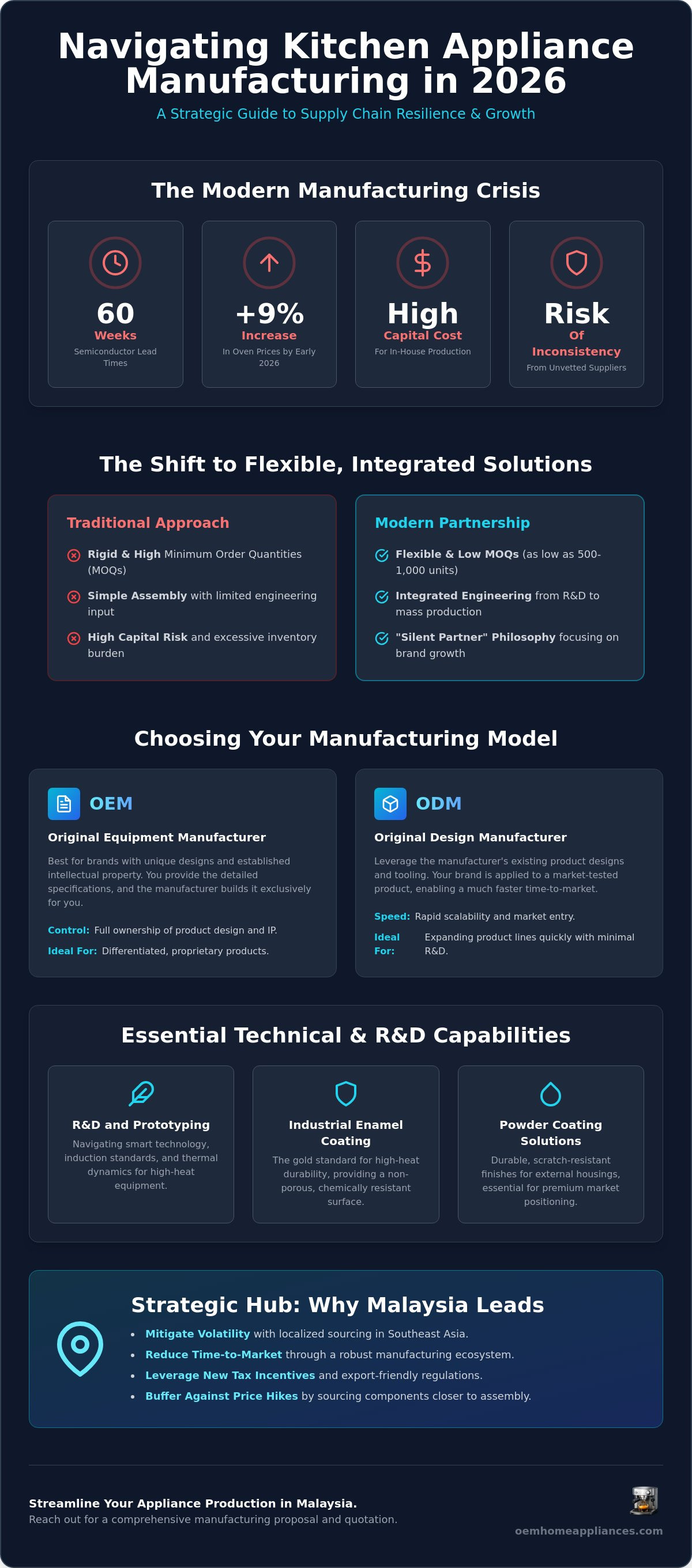
With semiconductor lead times stretching up to 60 weeks and raw material volatility driving oven prices up by 9% in early 2026, the traditional hands-off approach to sourcing is no longer viable. You've likely felt the pressure of high capital expenditure for in-house production or the frustration of inconsistent quality from existing suppliers. It's a common struggle for brands trying to maintain margins while demand for smart, energy-efficient appliances continues to rise.
Identifying the right kitchen appliance manufacturing solutions is the only way to stabilize your supply chain and protect your brand's reputation. This roundup outlines the essential manufacturing models and strategic partnerships that enable brands to scale efficiently this year. We'll examine how to reduce your time-to-market through rapid prototyping, the benefits of specialized surface finishing like enamel and powder coating, and why Malaysia's new tax incentives make it a primary hub for global production in 2026.
Table of Contents
Defining Modern Kitchen Appliance Manufacturing Solutions
Modern kitchen appliance manufacturing solutions are no longer just about owning a factory floor. They represent a complete lifecycle management system that starts with a conceptual sketch and ends with a retail-ready product. This approach integrates two distinct pillars: hardware solutions, such as automated assembly lines and robotics; and service-based solutions like Original Equipment Manufacturer (OEM) or ODM partnerships. It's a comprehensive framework designed to handle everything from technical drafting to final quality control.
In 2026, the industry is moving away from rigid, high-volume requirements. Brands now prioritize flexibility. While traditional factories demanded massive upfront commitments, modern kitchen appliance manufacturing solutions now offer lower Minimum Order Quantities (MOQs). For instance, ODM services for smart appliances can now be secured with MOQs as low as 500 to 1,000 units. This allows brands to test market reactions without the burden of excessive inventory or massive capital risk.
A successful partnership relies on a "silent partner" philosophy. The manufacturer exists to provide the industrial backbone, allowing the brand to focus on marketing and customer engagement. By avoiding direct-to-retail sales, the manufacturer ensures there is no conflict of interest with their clients. This relationship builds stability and long-term trust, positioning the manufacturer as a dependable extension of the brand's own team.
With a reliable manufacturing partner handling the technical complexities, brands are free to focus on high-level service delivery. For example, those looking to explore Bespoke Kitchen Design and Supply can prioritize the end-to-end luxury experience for their clients, knowing the underlying hardware meets the highest industrial standards.
The Shift from Assembly to Integrated Engineering
Brands don't just want assembly; they need differentiation. Integrated engineering is the fusion of design and mass-production feasibility. This process ensures that a sleek product design remains cost-effective and durable during high-volume production. Partners who provide R&D and prototyping help brands navigate the 2026 demand for smart technology and induction cooking standards. Technical solutions, such as precision enamel application, allow brands to position themselves in the premium market segment without building their own specialized facilities.
Supply Chain Resilience in 2026
Global logistics remain volatile. With semiconductor lead times reaching up to 60 weeks for certain components, localized sourcing is essential. Modern kitchen appliance manufacturing solutions mitigate these disruptions by utilizing regional hubs in Southeast Asia, specifically Malaysia. By sourcing components closer to the assembly point, manufacturers can significantly reduce lead times and buffer against the 30% to 60% price hikes seen in contract DRAM pricing this year. This regional focus provides the stability needed for long-term growth and predictable pricing.
Technical Solutions: Specialized Finishing and R&D
Research and development is the silent engine behind every market-ready product. It's the difference between a concept that looks good on paper and one that performs reliably in a consumer's kitchen. For high-heat equipment like roaster ovens or portable grills, the engineering stakes are high. Components must maintain structural integrity under extreme thermal cycles without warping or degrading. Effective kitchen appliance manufacturing solutions provide the specialized expertise required to navigate these thermal dynamics while meeting rigorous 2026 safety regulations.
Surface finishing is another critical technical solution that dictates both product lifespan and brand perception. It isn't merely an aesthetic choice; it's a functional requirement for durability. By integrating advanced finishing into the production line, brands can offer products that resist corrosion and maintain a premium look even after years of heavy use. If you're ready to discuss the technical requirements for your next appliance line, reach out to our engineering team for a consultation.
Industrial Enamel and Powder Coating Solutions
Enamel coating is the gold standard for high-heat durability in 2026. It provides a non-porous, chemically resistant surface that doesn't off-gas or release toxic fumes when exposed to the intense temperatures required for roasting or baking. Powder-coated metal components complement this by offering a durable, scratch-resistant finish for external housings. These coatings are essential for brands targeting the premium market where longevity is a key selling point. Modern technical standards now demand higher salt-spray resistance and better thermal shock performance, making these elite finishes a necessity for any competitive product lineup.
Kitchen Appliance Prototyping and Development
The journey from a conceptual sketch to mass production is fraught with potential engineering errors. Bespoke R&D services act as a safeguard, identifying flaws in airflow or heating element placement before they become costly manufacturing mistakes. This prototyping phase allows for the refinement of internal components in appliances like air fryers or rice cookers, ensuring optimal performance. You can find detailed technical specifications regarding our development capabilities on our OEM/ODM services page. Accessing the expertise found within Malaysia's electrical and electronics industry allows for a more resilient development cycle, supported by a world-class infrastructure of component manufacturers and testing labs.
Strategic Manufacturing Models: OEM vs. ODM Solutions
Selecting the right framework for production is a pivotal decision that dictates your brand's capital requirements and market agility. For established brands, Original Equipment Manufacturing (OEM) provides the highest level of design control. You own the intellectual property and the specific tooling used in production. While this requires a higher upfront investment-often ranging from $8,000 to $30,000 for specialized tooling-it ensures your products are truly unique. This model is the premier kitchen appliance manufacturing solutions choice when you have proprietary technology or a signature aesthetic that defines your brand.
Conversely, Original Design Manufacturing (ODM) offers a streamlined path to market. You leverage the manufacturer's pre-existing designs and engineering, which eliminates tooling costs and significantly reduces lead times. For brands looking to test new categories like air fryers or rice cookers, ODM provides a low-risk entry point with MOQs as low as 500 to 1,000 units. Many successful 2026 brands adopt a hybrid strategy. They utilize an existing chassis but customize the user interface, color schemes, and surface finishes to create a distinct brand identity without the full cost of ground-up engineering.
Private Label vs. White Label Strategies
Private label manufacturing is the most effective way to build brand equity without managing a factory. In this model, you customize a manufacturer's proven product with your branding and specific feature tweaks. It's different from white labeling, which involves selling generic products with no customization. For a deeper look at this process, consult our Strategic Guide to Selecting a Private Label Kitchen Appliance Manufacturer. Choosing the right partner ensures your private label line meets the high-quality standards your customers expect.
Technical Solutions for New Appliance Development
Balancing customization with cost is a constant challenge in appliance development. Effective contract manufacturing requires clear IP protection strategies to safeguard your market position. When developing complex products, refer to our Private Label Air Fryer Manufacturer guide for insights into R&D workflows. Integrating these kitchen appliance manufacturing solutions into your business plan allows you to scale production rapidly while maintaining the technical precision required for high-performance cooking equipment.
Regional Excellence: Why Malaysia Leads in Appliance Solutions
Malaysia has established itself as a premier destination for kitchen appliance manufacturing solutions due to its mature infrastructure and aggressive economic policies. As of 2026, the New Incentives Framework (NIF) offers a Special Tax Rate (STR) of 0% to 10% for up to 15 years for new manufacturing projects. This replaces older schemes and rewards companies based on economic complexity and sustainability. Additionally, the Accelerated Capital Allowance (ACA) of 60% available through December 31, 2026, allows businesses to reclaim capital expenditure faster. This improves cash flow for R&D-heavy projects and new product launches.
The region's technical talent is specifically concentrated in the electrical and electronics sector. This expertise is vital for developing complex appliances like induction cookers or smart air fryers. While other regional hubs face rising labor costs and geopolitical uncertainty, Malaysia provides a balanced environment of industrial strength and regulatory stability. If you're looking to capitalize on these regional advantages, contact us for a manufacturing consultation today. We can help you navigate the local landscape to maximize your production efficiency.
Sourcing Strategy: The Malaysia Advantage
Efficiency in production depends on the proximity of the supply chain. Malaysian appliance factories benefit from being at the heart of the ASEAN region, allowing for rapid access to key component suppliers. This reduces the risk of logistics bottlenecks and helps maintain consistent production schedules. High quality control standards are a hallmark of the local industry, ensuring that every unit meets the brand's specifications. Before finalizing your production plans, review our BBQ Grill Manufacturing Partner Checklist to ensure your supplier meets these rigorous regional standards.
Compliance and Global Standards
Exporting to European and North American markets requires strict adherence to safety certifications. Malaysian manufacturers are well-versed in international requirements like CE, UL, and Energy Star. In 2026, there's also an increased focus on Environmental, Social, and Governance (ESG) standards. Local production facilities are increasingly adopting sustainable practices to align with these global expectations. For technical details on compliance for specific categories, see our guide on OEM Kettle Safety Certifications. These certifications are a core part of our kitchen appliance manufacturing solutions, providing brands with the documentation needed for frictionless global distribution.
Implementing Your 2026 Manufacturing Strategy
Transitioning from internal production to a contract model requires a methodical shift in business logic. It isn't just about outsourcing assembly; it's about moving from a high-CapEx structure to a flexible, OpEx-driven strategy. In 2026, the complexity of kitchen appliance manufacturing solutions requires an audit that goes beyond basic facility checks. You must evaluate a partner's ability to handle integrated R&D, specialized finishing like enamel coating, and the specific engineering demands of high-heat appliances. This transition allows you to reallocate capital toward marketing and brand growth while leveraging industrial-scale efficiency.
A critical factor in your selection process is the manufacturer's stance on retail competition. You should prioritize a partner that operates strictly as a B2B facilitator. If a supplier also sells directly to consumers or through third-party branding agents, they are effectively competing with your brand using the same production lines. A "silent partner" approach ensures that the manufacturer's success is tied directly to your growth. Establishing long-term KPIs is the final step in this implementation. These metrics must include defect rates, lead time adherence, and material cost stability to ensure your supply chain remains resilient against market volatility.
Scaling with High-Volume Production Solutions
Managing bulk orders for roaster ovens, air fryers, and rice cookers requires a factory capable of maintaining consistency across thousands of units. Fluctuations in quality during large runs can lead to high return rates and brand damage. For brands looking to scale complex product lines, our High Volume Blender Manufacturing guide provides a strategic reference for maintaining technical precision at scale. These kitchen appliance manufacturing solutions ensure that the ten-thousandth unit off the line performs as perfectly as the first prototype.
Future-Proofing Your Appliance Brand
Consumer preferences in 2026 favor smart, energy-efficient, and aesthetically bold products. Adapting to these trends through internal production often requires expensive machinery upgrades. A flexible manufacturing partner acts as a "Trusted Expert Facilitator," allowing you to pivot your product lineup without the burden of obsolete equipment. Selecting an integrated solution provider that handles everything from design to final testing is the most effective way to ensure your brand remains competitive and agile. Additionally, brands that prioritize long-term performance often point their customers toward high-quality maintenance; for example, you can discover HomeFix for professional appliance repair services.
If you are ready to scale your production or develop a new line of kitchen appliances, contact us for a detailed quotation. We offer comprehensive manufacturing services within Malaysia, providing the technical expertise and regional trade advantages your brand needs to thrive in 2026. Reach out today to discuss your project requirements or to request pricing for your next production run.
Secure Your Competitive Advantage in 2026
The appliance market this year requires more than just a supplier; it demands a technical partner capable of navigating supply chain volatility and rising material costs. By integrating professional kitchen appliance manufacturing solutions, you shift from managing production bottlenecks to focusing on market expansion. We've explored how specialized enamel and powder coating provide the durability your customers expect, and why Malaysia's economic framework offers a strategic base for global exports.
Our dedicated B2B focus ensures that we never compete with your retail channels. We exist to empower your brand through expert OEM and ODM services that prioritize stability and precision. Whether you're launching a new line of air fryers or scaling roaster oven production, we provide the industrial backbone you need to succeed. Our team is ready to facilitate your growth with meticulous execution and global readiness.
Ready to scale your brand with world-class production in Malaysia? Contact us today for a customized quotation and let's build your next success together.
Frequently Asked Questions
What are kitchen appliance manufacturing solutions?
Kitchen appliance manufacturing solutions are integrated B2B services that manage the entire production lifecycle, from initial R&D and product design to final mass assembly. These frameworks provide brands with the industrial backbone needed to scale without the high capital expenditure of building their own factories. By leveraging a partner's expertise in specialized areas like enamel coating and international safety compliance, brands can focus on marketing while ensuring their products meet rigorous 2026 market standards.
How do OEM and ODM models differ in kitchen appliance production?
OEM (Original Equipment Manufacturing) involves producing appliances based on your proprietary designs and unique tooling, giving you total control over the product's specific features. ODM (Original Design Manufacturing) allows you to use the manufacturer's pre-existing designs, which minimizes upfront costs and speeds up market entry. While OEM is better for established brands seeking distinct differentiation, ODM is a strategic choice for businesses looking to test new categories with lower investment and faster turnaround times.
What are the benefits of sourcing appliances from Malaysia in 2026?
Malaysia offers significant strategic advantages in 2026 through the New Incentives Framework (NIF), which facilitates tax breaks for high-value manufacturing projects. Additionally, the region's established electrical and electronics infrastructure provides a stable supply chain for critical components. These factors, combined with a highly skilled technical workforce and export-friendly regulations, make Malaysia an ideal location for brands looking to optimize their global production costs while maintaining high quality standards.
Why is enamel coating important for roaster ovens and cookware?
Enamel coating is critical for high-heat appliances because it provides a non-porous, heat-resistant surface that ensures both food safety and product durability. This specialized finish is essential for roaster ovens and portable cooking equipment that must withstand extreme thermal cycles without degrading. Beyond its functional benefits, enamel offers a premium, scratch-resistant aesthetic that enhances brand perception. It's a high-value technical solution for brands targeting the professional and premium consumer segments in 2026.
Can a manufacturer help with both design and mass production?
Yes, a comprehensive manufacturer manages both the design phase and mass production through an integrated engineering workflow. This process ensures that new concepts are optimized for production efficiency and cost-effectiveness before the first unit is assembled. By handling the transition from R&D to high-volume manufacturing internally, the partner reduces the risk of engineering errors. This provides you with a friction-free path from a conceptual sketch to a shelf-ready product.
How do I ensure quality control when outsourcing appliance manufacturing?
Maintaining quality control requires a combination of clear technical specifications and a partner that utilizes advanced kitchen appliance manufacturing solutions. You should establish measurable KPIs for defect rates and material consistency while ensuring your manufacturer conducts rigorous testing for international safety certifications. Regular factory audits and a focus on specialized finishing techniques, such as precision powder coating, are also essential for protecting your brand's reputation and ensuring product longevity in competitive retail environments.
What is the typical timeline for appliance prototyping and R&D?
The timeline for prototyping and R&D varies based on product complexity, but it typically spans several months. In 2026, the integration of smart technology and AI features can extend this period, especially with global semiconductor lead times reaching up to 60 weeks. To stay competitive, it's vital to work with a partner that uses efficient design-to-production workflows and localized sourcing within Southeast Asia to minimize delays and accelerate your product's entry into the market.
Does oemhomeappliances compete with its retail brand clients?
No, our business model is strictly dedicated to B2B services, meaning we don't compete with our clients in the retail space. We function as a trusted facilitator and a silent partner, providing the industrial strength required to bring your designs to life. This approach eliminates any conflict of interest and ensures our goals are fully aligned with your brand's growth and long-term market success. We exist to empower your brand, not to rival it on the shelf.


Enhancing Your Manufacturing Strategy with Plastic Injection Molding
Incorporating plastic injection molding into your manufacturing strategy offers clear advantages. It supports high-volume production with consistent quality, reduces lead times, and allows for complex designs that meet modern product demands.
By collaborating with experienced plastic injection molding services, you gain access to expertise that can guide you through every stage—from initial concept to final assembly. This partnership ensures your products are manufactured efficiently, reliably, and at scale.
If you want to enhance your manufacturing capabilities and bring diverse products to market faster, plastic injection molding is a solution worth considering. It’s a proven technology that continues to evolve, offering new opportunities for innovation and growth.
By understanding and applying the plastic…