The Strategic Guide to Sourcing a Private Label Electric Kettle Manufacturer in 2026
In 2026, your brand's market position depends on more than just a sleek silhouette; it relies on meeting a 0.50-watt standby power limit and ensuring zero-defect thermal performance. As global recalls and stricter EU Product Liability rules reshape the industry, selecting the right private label electric kettle manufacturer has become a high-stakes strategic decision. You understand that a generic product won't differentiate your brand, especially when consumers demand energy efficiency and industrial-grade durability. Inconsistent heating or fragile exterior housing can destroy years of brand equity in a single production cycle.
We agree that finding a partner who balances aesthetic customization with rigorous engineering is your top priority. This guide provides the framework to evaluate technical R&D capabilities, bespoke industrial finishing, and the manufacturing scalability needed for global distribution. You'll learn how to identify a partner that doesn't just supply a product but acts as a silent engine for your growth. We'll analyze the essential benchmarks for material science, safety compliance, and the precision required to dominate the 1.99 billion dollar global kettle market.
Table of Contents
The Evolution of Private Label Electric Kettle Manufacturing
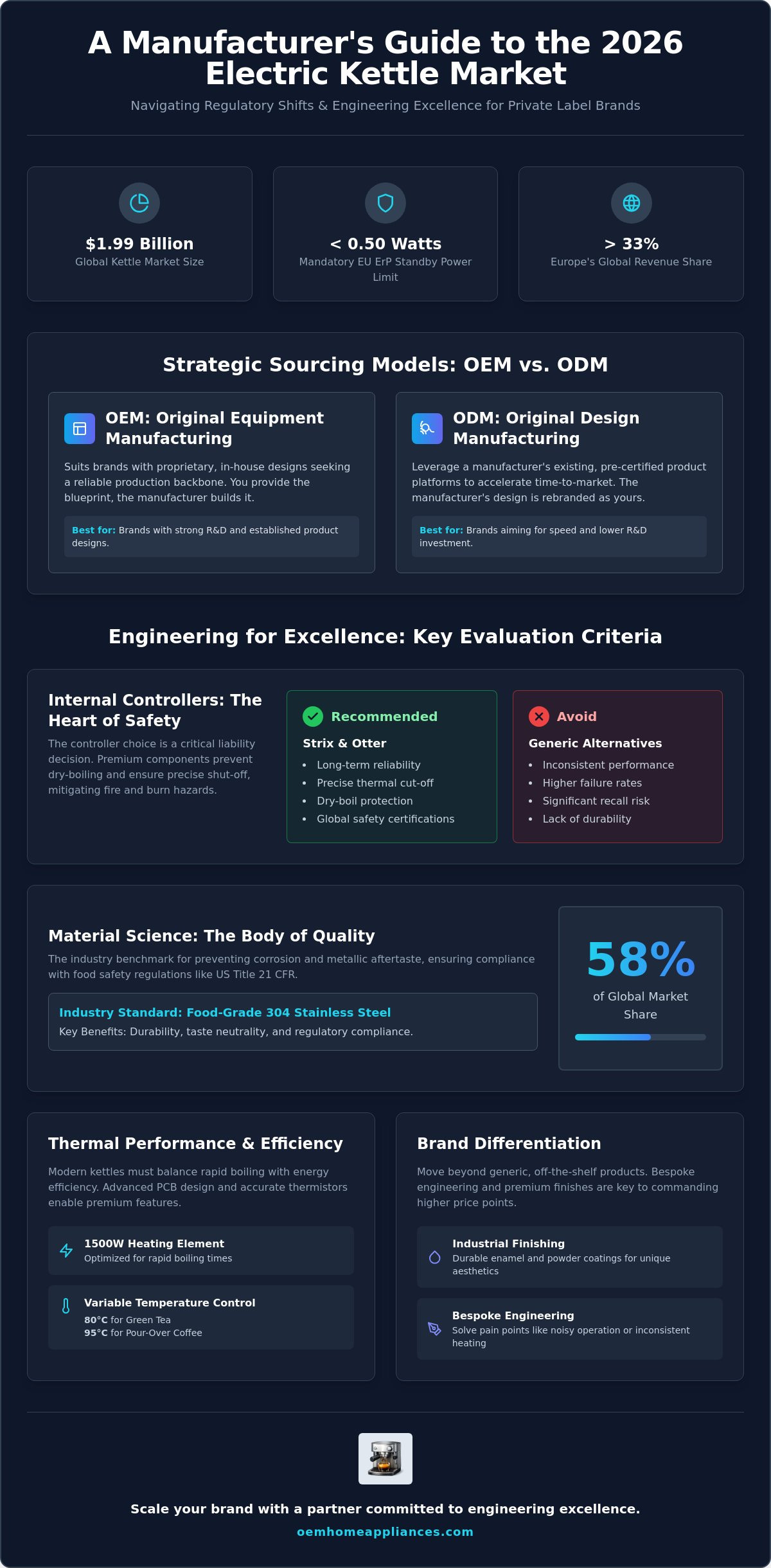
The 2026 market for electric kettles is no longer a race to the bottom on price. It's a race for technical compliance and energy efficiency. With the EU ErP Directive now mandating standby power consumption below 0.50 watts, the role of a private label electric kettle manufacturer has evolved from a simple assembly plant to a sophisticated R&D partner. Brands that rely on outdated designs risk being locked out of major markets like Europe, which currently holds over 33% of the global revenue share. Understanding The Evolution of Electric Kettles helps illustrate why we've moved past basic boiling toward precision thermal management and smart integration.
Choosing between Original Equipment Manufacturing (OEM) and Original Design Manufacturing (ODM) is a foundational strategic choice for your brand. OEM models suit brands with proprietary designs seeking a reliable production backbone. Conversely, ODM allows businesses to leverage a manufacturer's existing, pre-certified platforms to accelerate time-to-market. Established brands are increasingly bypassing generic trading agents. They prefer direct factory partnerships that offer supply chain resilience and direct access to engineering teams. This shift ensures that your brand doesn't just sell a commodity, but a product backed by industrial stability.
The Shift from Commodity to Premium Private Label
Generic, "off-the-shelf" kettles fail to meet the 2026 consumer's expectation for durability and aesthetic distinction. Market leaders now prioritize bespoke engineering to solve common pain points like inconsistent thermal performance or noisy operation. By working with a specialized private label electric kettle manufacturer, you gain access to advanced material science, such as high-grade stainless steel or powder-coated metal components. This transparency in the manufacturing process builds long-term consumer trust. It's especially vital as new "Right to Repair" rules make product longevity a key selling point in the premium appliance sector.
B2B Sourcing Models for Global Distribution
Successful multi-region launches require high-capacity production lines and meticulous technical documentation. A direct factory partnership ensures your procurement team receives the necessary UL 1026 or CE certifications without the delays common to third-party branding agents. High-volume manufacturing must be supported by automated testing labs to maintain quality across thousands of units. This level of industrial readiness is essential for navigating the complex regulatory environment of 2026. New product liability rules now hold more parties accountable for defects, making a manufacturer's internal quality control your brand's strongest shield.
Evaluating Technical R&D and Engineering Standards
A high-quality private label electric kettle manufacturer must do more than assemble components. They must engineer for long-term reliability. The difference between a premium appliance and a significant liability often lies in the choice of the internal controller. Selecting Strix or Otter controllers provides a level of safety and durability that generic alternatives can't match. These components prevent dry-boiling and ensure the kettle shuts off precisely at the boiling point. This protects your brand from the burn hazard risks that led to major consumer recalls in early 2026.
Material science is equally critical to your product's success. Food-grade 304 stainless steel remains the industry benchmark, holding nearly 58% of the global market share. It resists corrosion and prevents metallic aftertastes, ensuring compliance with US Title 21 Code of Federal Regulations. Engineering teams must also optimize wattage for thermal efficiency. In 2026, balancing a 1500W heating element with rapid boil times requires precise internal geometry and high-quality insulation. For brands looking to refine these specifications, the private label manufacturing services at oemhomeappliances.com offer the technical expertise needed to balance performance with safety.
Precision Engineering for Performance
Modern consumers expect precision. Integrating variable temperature control allows users to heat water for specific beverages, such as 80°C for green tea or 95°C for pour-over coffee. This requires advanced PCB design and accurate thermistors. Engineering for durability also includes the exterior housing. Applying high-performance Powder Coating Systems ensures the kettle housing remains heat-resistant and aesthetically consistent over thousands of cycles. In 2026, UL, CE, and RoHS certifications serve as the essential baseline for market entry, ensuring every component meets global safety and environmental safety benchmarks.
The Prototyping and Testing Workflow
The journey from a CAD drawing to a functional gold sample is iterative. A reliable partner conducts rigorous stress testing on lid hinges and handle ergonomics to prevent the detachment issues seen in recent market recalls. They use 3D printing for rapid prototyping, which lets you test the physical feel before committing to expensive tooling. Consistency is the final hurdle. Mass production must mirror the approved prototype exactly. This requires a manufacturer with automated assembly lines and in-house testing labs that verify every batch against the original engineering specs.
Industrial Finishing: Enamel and Powder Coating for Brand Differentiation
In a market saturated with generic stainless steel, exterior finishing is the primary lever for brand differentiation. A specialized private label electric kettle manufacturer uses industrial-grade coatings to transform a standard appliance into a premium kitchen centerpiece. While internal specs ensure performance, the exterior finish drives the initial purchase decision and justifies a higher retail price point. Moving beyond standard polished metal allows your brand to capture the growing segment of consumers seeking aesthetic appliances that complement modern kitchen decor.
Enamel-coated metal components offer superior heat resistance compared to standard liquid paints. This finish is fused to the metal at high temperatures, creating a surface that won't peel, chip, or discolor under the intense heat of daily boiling. It provides a classic, high-gloss look that resonates with premium heritage brands. For a more contemporary feel, powder coating provides a durable, textured surface that resists scratches and fingerprints. Unlike plastic housings that feel flimsy and can degrade over time, powder-coated metal conveys a sense of industrial strength and long-term reliability.
Customization is not limited to texture. Precise Pantone color matching ensures your kettle collection aligns perfectly with other products in your brand's ecosystem. Whether you're launching a "matte midnight" series or a vibrant "retro red" line, consistency across your product suite is essential for building brand recognition. This level of detail transforms a simple utility into a lifestyle product, encouraging repeat purchases across your entire appliance range.
The Durability of Enamel and Powder Coated Components
Industrial coatings are essential for preventing corrosion in high-moisture kitchen environments. Steam and frequent handling can quickly degrade inferior finishes, leading to unsightly wear. Specialized coatings maintain their aesthetic appeal even in high-use scenarios, ensuring your brand's reputation for quality remains intact. These same durability standards apply to our BBQ grill manufacturing partner solutions, where heat resistance and weatherproofing are equally critical. Using these advanced finishes across your product lines ensures a unified standard of excellence that consumers can feel.
Aesthetic Alignment and Brand Identity
Creating a unique tactile experience is a subtle but powerful way to build brand loyalty. The weight of a metal housing combined with a premium powder-coated grip provides a sense of quality that plastic alternatives simply cannot match. You can further integrate your brand identity by incorporating laser-engraved logos or custom-molded brand elements directly into the housing. This meticulous attention to metalwork justifies a premium price point and positions your product as a durable investment rather than a disposable commodity. By focusing on these high-touch details, you differentiate your brand in a crowded marketplace and build a lasting connection with your target audience.
Strategic Sourcing: The Factory Audit Checklist for 2026
Successful sourcing in 2026 requires moving beyond transactional "verified" badges found on global marketplaces. A private label electric kettle manufacturer must demonstrate industrial maturity through a rigorous infrastructure assessment. When you audit a facility, prioritize production line automation. High levels of automation minimize human error and ensure every unit adheres to the strict 0.50-watt standby power regulations now standard in major markets. Manual assembly often leads to the inconsistent thermal performance that destroys brand reputation.
Verifying R&D depth is your next priority. A capable partner maintains in-house engineering teams and testing labs dedicated to product evolution. You should review their life-cycle testing protocols for lid mechanisms and their thermal shock testing for heating elements. Quality Control (QC) must be integrated at every stage. This starts with testing raw 304 stainless steel for purity and continues through final assembly. If a manufacturer can't provide batch-testing data for their raw materials, they aren't a suitable partner for a premium brand.
Logistics and compliance are the final pillars of a successful audit. Review the factory's export history to ensure they understand the regulatory nuances of your target regions. Lead-time reliability is critical for maintaining inventory levels during high-demand cycles. For brands seeking a partner with a proven track record in global compliance, you can explore our private label manufacturing capabilities to see how we maintain industrial-grade standards across all product lines.
Essential Criteria for Manufacturer Selection
ISO 9001 certification is the absolute baseline for any professional manufacturing partnership. However, you must also verify industry-specific safety certifications such as UL 1026 or GS. Assess the manufacturer's history with other global appliance brands to gauge their ability to handle complexity. High-volume production runs require more than just floor space; they require sophisticated resource planning systems. Ensure the factory has the capacity to scale without compromising the precision of your custom industrial finishes.
Communication and Project Management
Clear communication is the backbone of a reliable B2B partnership. Insist on a dedicated project manager who serves as your primary technical contact. This ensures that your brand’s specific engineering requirements don't get lost in translation. Transparency in the production timeline is non-negotiable. You should receive regular milestone reporting that includes real-time data on production yields and QC results. Finally, evaluate their post-production framework. A manufacturer that stands behind their work with robust technical support and clear warranty terms is a partner you can trust for the long term.
Scaling Your Brand with oemhomeappliances and Keiteq
Selecting a private label electric kettle manufacturer is a commitment to your brand's long-term stability and market reputation. oemhomeappliances and Keiteq serve as the industrial backbone for established home appliance brands seeking to expand their product lines without the overhead of internal production. We operate with a strict B2B focus. This means we don't compete with our clients in the retail or distribution space. Our success is entirely tied to your brand's growth and the performance of your product in the global marketplace.
Our integrated production model provides a significant competitive advantage. We maintain specialized in-house facilities for enamel and powder coating, ensuring that every kettle meets the aesthetic and durability standards discussed in previous sections. By controlling the finishing process internally, we eliminate the quality variances and lead-time delays associated with third-party coating vendors. This vertical integration allows us to deliver bespoke OEM and ODM solutions that align perfectly with your 2026 product roadmap and regional compliance requirements.
Leveraging our global manufacturing strength gives your brand the flexibility to scale rapidly. Whether you're launching a limited-edition designer collection or a high-volume base model, our infrastructure adapts to your specific volume needs. We provide the technical precision and industrial capacity required to dominate a crowded market. You gain a partner that understands the nuances of global supply chains and the rigorous demands of modern retail environments.
Comprehensive Manufacturing and R&D Solutions
Our R&D services transform initial kettle concepts into market-ready products through a methodical engineering process. We handle everything from CAD development to functional prototyping and safety certification. This end-to-end support ensures your product enters the market with zero technical debt. We also apply cross-category insights from our work in custom roaster oven manufacturing to enhance thermal efficiency and material durability across all appliance lines. This broad expertise allows us to anticipate manufacturing challenges before they impact your production schedule.
Initiating Your Next Production Cycle
The roadmap from your initial inquiry to global shipping is designed for transparency and speed. We begin with a detailed consultation to define your technical specifications and custom finishing requirements. Our project managers provide clear milestones, ensuring you stay informed during the prototyping, tooling, and mass production phases. We don't just deliver a product; we deliver a verified, compliant, and aesthetically superior appliance that elevates your brand's market position. Contact us to discuss your private label electric kettle manufacturer requirements and secure your production capacity for the 2026 season today.
Securing Your Brand's Industrial Future
Dominating the 2026 appliance market requires a transition from generic sourcing to strategic engineering. We've analyzed how the right partner balances strict energy compliance with bespoke industrial finishing to create a product that justifies a premium retail position. Success depends on verifying a manufacturer's R&D depth and their ability to maintain consistency across high-volume production runs. Your brand's reputation relies on the stability of your supply chain and the precision of your hardware. It's no longer enough to simply boil water; you must provide a durable, energy-efficient experience that resonates with modern consumers.
Choosing a dedicated private label electric kettle manufacturer provides the industrial backbone needed for global expansion. We offer specialized industrial enamel and powder coating facilities alongside dedicated B2B R&D and prototyping teams to transform your concepts into market-ready assets. As a trusted manufacturing partner for global appliance brands, we focus exclusively on your growth without direct retail competition. It's time to build a product line that reflects your brand's commitment to quality and innovation.
Partner with a leading private label electric kettle manufacturer today and secure your competitive edge for the upcoming season.
Frequently Asked Questions
What is the main difference between OEM and ODM for electric kettles?
OEM involves manufacturing a product based on your brand's unique blueprints and proprietary tooling. ODM allows you to select a pre-engineered design from the manufacturer's catalog and apply your specific branding elements. Choosing a private label electric kettle manufacturer with both capabilities provides flexibility as your brand matures. Most established brands start with ODM to test the market before investing in proprietary OEM tooling for exclusive product lines.
What are the typical MOQs for a custom private label electric kettle?
Minimum Order Quantities (MOQs) typically range from 1,000 to 3,000 units for standard models. Customizations such as unique Pantone color matching or bespoke handle molds often increase these requirements. Higher MOQs ensure production efficiency and allow the factory to amortize setup costs for custom industrial finishes. Always confirm if the MOQ applies per SKU or per production batch to better manage your inventory levels and storage costs.
How long does the prototyping phase take for a new kettle design?
The prototyping lifecycle generally spans 4 to 8 weeks from the initial CAD approval to the delivery of a functional gold sample. This timeline includes 3D printing for ergonomic testing and the assembly of internal heating components. Rapid prototyping allows your team to verify lid mechanisms and handle heat resistance before committing to mass production tooling. Complex designs with integrated electronics or variable temperature controls may require additional time for PCB debugging.
Can a private label electric kettle manufacturer provide custom enamel finishes?
Specialized manufacturers offer industrial enamel and powder coating as a primary differentiator for premium brands. These finishes provide superior heat resistance and a high-end tactile feel that plastic alternatives cannot match. Utilizing a private label electric kettle manufacturer with in-house coating facilities ensures color consistency across your entire appliance collection. This integrated approach prevents the delays and quality variances often found when using third-party finishing vendors during the production cycle.
What safety certifications are mandatory for kettles in the North American market?
The North American market requires UL 1026 or ETL certification for household electric cooking appliances. These standards ensure the kettle meets rigorous fire safety and electrical grounding requirements. If your product includes smart features, FCC certification is also mandatory for wireless communication components. Compliance with FDA standards for all food-contact materials is essential to prevent chemical leaching and ensure consumer safety across your entire product line.
How is quality consistency maintained across high-volume production runs?
Consistency is maintained through high-level automation and multi-stage Quality Control (QC) protocols. Automated assembly lines minimize human error in critical areas like sensor placement and internal wiring. Factories perform batch testing on raw 304 stainless steel and conduct 100% functional testing on the final assembly. This rigorous approach ensures that every unit matches the thermal performance and safety standards established during the prototyping phase, protecting your brand from costly recalls.
Is it possible to develop a smart kettle with app integration through an OEM?
Developing a smart kettle with app integration is a standard service for advanced OEM partners. This involves integrating IoT modules that allow users to control temperature and scheduling via a smartphone. The smart kettle segment is expanding at a CAGR of 9.86% through 2031, reflecting a strong shift in consumer demand for connected appliances. A capable manufacturer handles the hardware integration while providing the necessary technical documentation for your software development team.
What materials are best for the interior of a premium private label kettle?
Food-grade 304 stainless steel is the benchmark material for premium kettle interiors. It currently holds a 57.92% market share due to its superior corrosion resistance and lack of chemical leaching. Borosilicate glass is an alternative for brands focusing on visual transparency and BPA-free marketing. Both materials ensure the water remains pure and free from metallic aftertastes, which is vital for maintaining the flavor profiles of specialty teas and coffees.


Comments